

In this article
01/18Good structuring starts with the commercial objective, not the jurisdiction, bank or product.
01
The email that arrived on a Tuesday
It came from the bank, three years after everything had been set up perfectly.
“As part of our periodic review, please provide updated ownership documents, board resolutions for the last two financial years, and evidence of the company’s activities. Failure to respond within 30 days may result in restrictions on the account.”
Let’s call the founder Karim. He is a composite of the people we meet every month, and his story is common enough that you may recognise parts of it.
Karim had done things properly. A UAE holding company. A free zone trading company beneath it. A separate entity for the family’s Dubai apartment. A lawyer drew the chart, the licences arrived, the bank accounts opened. On paper, it was clean.
Then life happened. A partner left and his shares were bought back, but nobody updated the register. Board decisions were made on WhatsApp calls from three countries and never written down. A licence renewal slipped by a few weeks. The corporate tax registration was done for one entity and forgotten for another.
None of it felt urgent. Until the email.
This article is about the difference between a structure that was built right and one that is run right. The first is corporate structuring. The second is corporate governance. You need both, and most people only pay attention to the first.
02
In short
Corporate structuring is how your companies are arranged: which entities exist, where they sit, and who owns what.
Corporate governance is how those entities are run every year: decisions, records, filings and renewals.
Structures rarely fail at setup. They drift afterwards, usually at three moments: the first filing year, the first bank review, and the first big life change.
In the UAE, every entity carries its own yearly obligations, even an SPV with no staff.
One owner and one calendar across the whole structure is what keeps it credible to banks, regulators and investors.
03
What is corporate structuring?
Corporate structuring is the way you arrange your companies so that each one has a clear job. One entity trades. Another holds shares. Another owns a property or ring-fences a single deal. Another protects family wealth for the next generation.
A good structure answers four questions before a single licence is issued:
1. What is each entity for? Operating, holding, owning an asset, or protecting wealth.
2. Where should it sit? Chosen for banking access, treaty networks and substance requirements, not the headline tax rate alone.
3. Who owns and controls it? Ownership lines a bank compliance officer can follow in minutes.
4. How will it grow? Room for new investors, new assets or new family members without rebuilding everything.
04
What is corporate governance?
Corporate governance is everything that keeps those entities credible after day one. It is the board meeting that gets minuted. The register that is updated when a shareholder changes. The licence renewed before it lapses. The tax return filed for every entity, not just the busy one.
If structuring is the architecture of a building, governance is the maintenance. Nobody notices it when it is done well. Everybody notices when it is not.
05
Why the two must work together
Regulators, tax authorities and especially banks now judge a structure by how it operates, not just how it was drawn. A beautifully designed group with missing minutes and stale registers looks, to a compliance team, exactly like a structure with something to hide. That is why Karim’s email arrived.
06
The three moments where structures break
Karim’s structure did not fail on one day. It drifted, quietly, through three moments that almost every cross-border business goes through.
07
Moment 1: The first filing year
The excitement of setup fades and the calendar takes over. Each entity now has its own licence renewal, its own corporate tax registration and return, its own accounting records, and sometimes its own audit. They fall due on different dates, sometimes in different countries.
Karim’s accountant handled the trading company well. The holding company, which had no revenue, slipped through. “It doesn’t do anything, so it doesn’t need anything,” he assumed. In the UAE, that is not how it works: every juridical person registers and files for corporate tax, even with nothing to report.
The lesson: a quiet entity is not an exempt entity.
08
Moment 2: The first bank review
Banks review corporate clients periodically, and more often when ownership is spread across borders. They want the current shareholder register, the ultimate beneficial owners, recent board resolutions and evidence that the company does what it says it does.
This is where governance gaps become visible. The partner who left was still on the register. The decisions behind a large transfer were never minuted. The documents no longer matched the structure the bank had approved.
The lesson: your bank remembers the structure you showed it. Your records need to keep up.
09
Moment 3: The first big life change
A new investor. The sale of a property. A child joining the business. A health scare that makes everyone ask, quietly, what happens next.
These are the moments a structure is supposed to make easy. Instead, Karim discovered that nobody could say with certainty who controlled what, because the paperwork had stopped at year one.
The lesson: a structure’s real test is not the day it is created. It is the day something changes.
10
What a well-built structure looks like
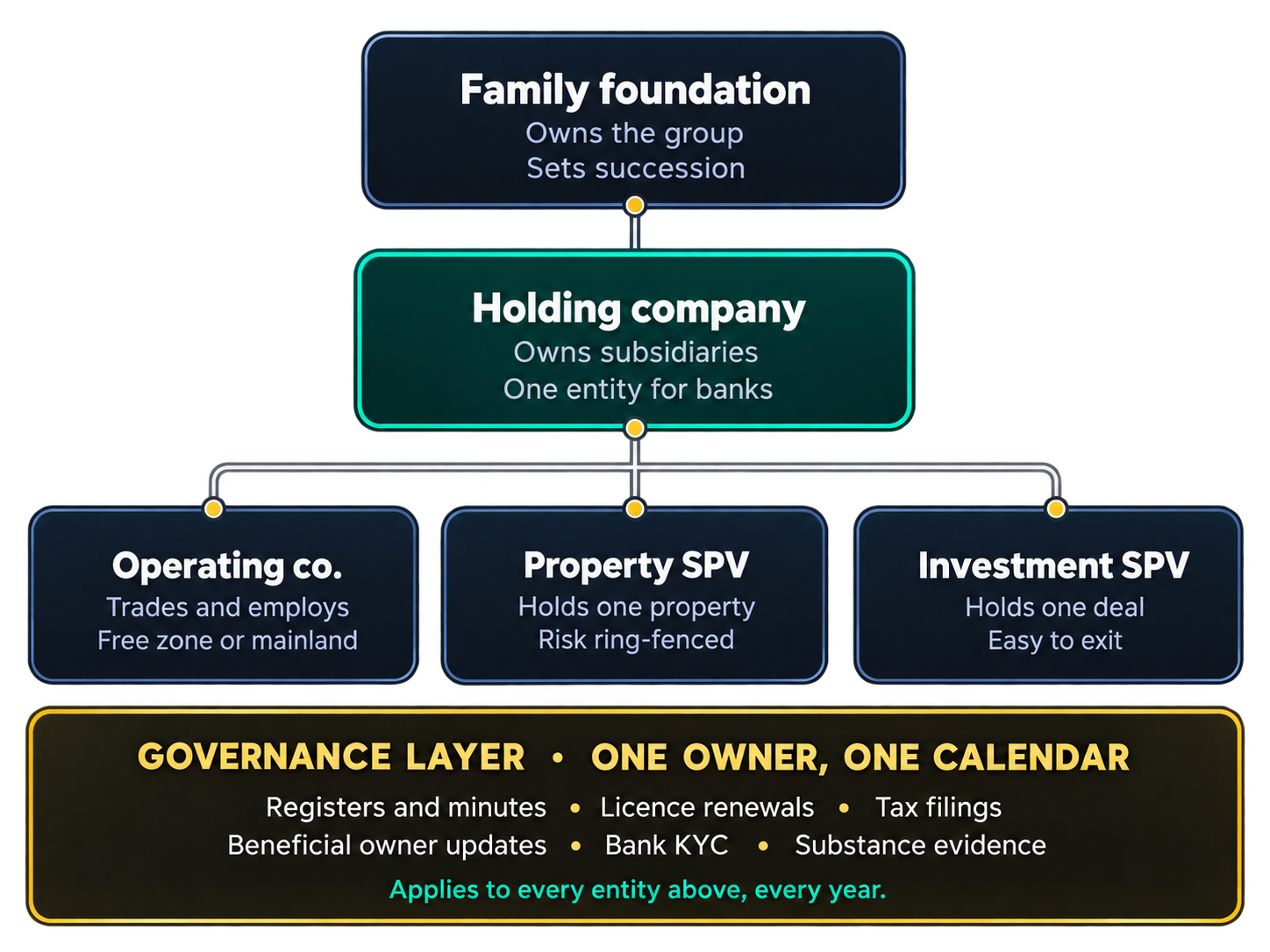
Here is the shape Karim’s group should have had from day one, with each entity doing exactly one job.
Control and succession sit in the foundation, management in the holding company, and risk in separate vehicles. The governance layer underneath is what most groups forget to build.
11
The yearly governance calendar for UAE entities
This is what “running a structure right” looks like in practice. Every line applies per entity, so a group of four companies carries four sets of obligations.
Rules change, and free zones add their own requirements. The details reflect UAE federal rules as of October 2026 and should be confirmed for each entity.
| Obligation | What it involves | How often |
|---|---|---|
| Licence renewal | Renew trade or commercial licence, registered office and any regulatory permissions | Every year |
| Shareholder and board decisions | Hold and minute annual general meeting and record major decisions | At least yearly and for every major decision |
| Beneficial owner register | Maintain beneficial owner register; report changes to registrar | Within 15 days of any change |
| Corporate tax | Register each entity; file tax return and pay any tax due | Within 9 months of tax period end |
| Accounting records | Maintain books and supporting documents | Retain for at least 7 years |
| Audited financial statements | Required for qualifying free zone persons, large-revenue companies and some free zones | Annually, where applicable |
| Transfer pricing | Arm's-length related-party transactions and disclosures | Annually, where applicable |
| VAT | Register above AED 375,000 taxable supplies and file returns | Usually quarterly |
| E-invoicing | Appoint accredited provider and adopt structured e-invoices | Phased from 2027 |
UAE rules cited in the October 2026 source article; verify current requirements for each entity.
12
What this looks like across borders
Add a foreign holding company, a BVI vehicle or a family foundation, and each one brings its own registry, its own deadlines and its own regulator. This is where most groups lose the thread: not because any single obligation is hard, but because nobody holds all of them in one place.
13
Governance for families: when the structure has to outlive you
For families, governance has a second job. It is not only about staying compliant. It is about making sure the people you care about inherit clarity instead of confusion.
Three tools do most of the work:
A foundation or trust at the top, so ownership does not depend on one person’s estate. A foundation has no shareholders and is governed by its charter and by-laws.
A written succession plan, covering who takes decisions if the founder cannot, and how shares or benefits pass to the next generation.
A family charter or shareholder agreement, setting out how family members join the business, how disputes are resolved, and how value is shared.
None of these work if the entities beneath them are out of date. A foundation that owns a holding company with a stale register is a clear plan sitting on top of an unclear group.
14
How Karim’s story ended
Karim answered the bank, eventually. It took six weeks, two lawyers and a great deal of stress to rebuild three years of missing records.
Then he did what he should have done on day one. Every entity was mapped on one page, with a clear job. The registers were brought up to date. Past board decisions were properly ratified. One governance calendar now covers every licence, filing and renewal across the group, with one person accountable for it.
When the next bank review arrived, it took two days.
The structure did not change much. What changed was that it was finally being run, not just owned.
15
Is your structure running right? A two-minute check
Tick every statement that is true for all your entities:
Shareholder, director and beneficial owner registers are current.
Board decisions are minuted where each company is managed.
Every licence and renewal sits on one calendar.
Corporate tax returns are filed for every entity, including quiet ones.
You can show evidence of real activity if a bank asks.
Bank KYC documents match today’s structure.
Someone is named as responsible for all of the above.
All seven: your structure is built to last. Four to six: gaps are forming, and it is cheaper to close them now. Three or fewer: a full governance review is overdue.
Your governance checklist
0 of 7 complete
The checklist is illustrative and is not a compliance opinion.
16
How Orpheus helps
Orpheus Financial designs cross-border structures and then stays with them. Across 18 jurisdictions, we establish the entities, holding companies and ownership structures that families, investors and businesses need, and we manage the governance, compliance and statutory obligations that keep them credible year after year.
That means one partner who holds the whole picture: the structure chart, the calendar, the registers and the relationship with your banks.
Orpheus is also the structuring partner for LuxuryProperty.com Wealth Management, where clients can access global corporate structuring and family office structuring alongside their property, wealth and succession planning.
Built right. Run right. Request a private review with Orpheus.
17
Frequently asked questions
What is the difference between corporate structuring and corporate governance?
Corporate structuring is how your entities are arranged and owned. Corporate governance is how they are run and kept compliant each year. Structuring happens mostly at the start; governance never stops.
Is corporate governance a legal requirement for UAE companies?
Yes. Every UAE company has statutory duties, including keeping registers current, renewing its licence, maintaining accounting records and filing corporate tax returns.
Do holding companies and SPVs need governance if they have no staff?
Yes. An entity with no employees still needs documented decisions, current registers, a valid licence and its annual tax filings. Quiet entities are the ones most often missed.
How often do banks review corporate accounts in the UAE?
Banks review corporate clients periodically, and more often for groups with owners or entities in several countries. Being able to produce current registers, recent resolutions and evidence of activity quickly makes these reviews routine.
What is a beneficial owner register?
It is a record of the individuals who ultimately own or control a company. UAE companies must keep it up to date and report changes to their registrar within the set deadline.
Can one provider manage governance for entities in several countries?
Yes, and it is usually the safest approach. One owner and one calendar across the whole structure prevents deadlines falling between different advisers.
When should a family add a foundation to its structure?
When the main question shifts from how the business is run to what happens to it after the founder. A foundation separates ownership from any one person's estate and sets succession rules in advance.
How long does it take to fix a structure with governance gaps?
It depends on how many entities are involved and how far records have drifted. Fixing it before a bank or regulator asks is always faster and cheaper than fixing it under a deadline.
Can I move my free zone company to the mainland?
The law now allows it, where both the free zone and the mainland authority approve and their procedures support the transfer. Ask both authorities about your specific route first.
Does my company keep its legal identity if it re-domiciles?
Yes. A re-domiciled company keeps its legal personality, rights, obligations and contracts. Its licences need approval from the new authority and do not transfer automatically.
Do shareholders need to approve a re-domiciliation?
Yes. It needs a special resolution or the required majority of shareholders, as well as approval from both authorities.
Can a UAE LLC have preferred shares?
LLCs can now have different share classes, which can include preference-type rights. The permitted classes are set by Cabinet decision, so confirm what is available before agreeing terms.
How can minority investors protect their exit?
A tag-along clause lets them sell on the same terms as the majority. It must be written into the memorandum or articles and drafted to work with pre-emption rights.
Can my partners buy my shares if I die?
Yes, if the company documents give them or the company a priority right to buy. Your heirs remain entitled to the value under the applicable inheritance law.
Do I need to amend my memorandum now?
Not necessarily. Existing documents stay valid. Amend them if you want to use the new options, such as exit clauses, share classes or succession buy-outs.
18
Disclaimer
This article is for general information and education only and does not constitute legal, tax, financial or investment advice. It reflects our understanding of the law as at 30 October 2026. UAE laws, implementing regulations and authority guidance may change, and how they apply depends on your company's legal form, licensing authority and circumstances. Take independent advice from a qualified UAE lawyer before restructuring a company, amending constitutional documents, transferring shares or entering a transaction. Orpheus Financial is not a law firm and does not provide legal services.