
 Rachit Yadav
Introduction
Raising money does not make a founder a private banking client.
It is the most common misreading of this market. A round closes, the company balance sheet goes from thin to healthy, and the founder assumes the door to a private bank has opened with it. It has not. The capital sits with the company. Private banking tiers are assessed on what the individual holds, and on most measures the founder of a well funded company can sit below every threshold in the market.
The two things are not connected, and treating them as one question is what sends founders into the wrong conversation with the wrong institution.
This piece covers the second question. What a founder personally needs in order to qualify, what is actually published, and what the figures circulating online are worth.
Two problems that look like one
Almost every founder in the UAE is dealing with two separate banking problems at the same time.
The first is banking the company. An operating account that can receive revenue, pay salaries and clear international transfers. This is a compliance exercise, and for a young company it is frequently the harder of the two.
The second is banking the founder. A personal relationship with a bank’s private or priority arm, assessed on personal assets, giving access to lending, custody, discretionary mandates and cross-border structuring.
Different institutions, different teams, different criteria, often different jurisdictions. A founder who solves the first and assumes the second follows is usually surprised.
Most UAE banks do not publish a minimum
This is the finding that should change how you read anything else on the subject.
Search for the minimum balance for private banking in the UAE and you will find a dozen confidently stated figures. Compare them against each other and most of them disagree.
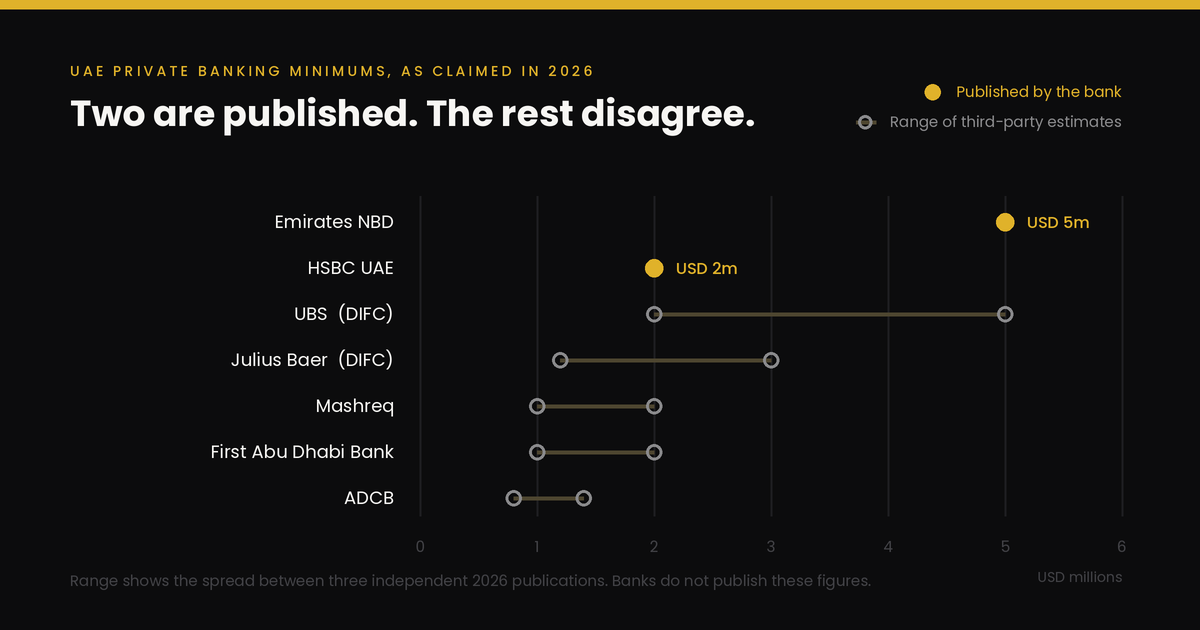
Across three independent sources published during 2026, only two institutions give a figure that holds steady:
| Bank | Tier | Stated threshold |
|---|---|---|
| Emirates NBD | Private Banking | USD 5 million in AUM |
| HSBC UAE | Private Bank | USD 2 million total relationship balance |
For everyone else the picture falls apart on contact. One source lists ADCB as not published, another gives AED 4 million, a third gives a range of AED 3 million to AED 5 million. Mashreq appears as not published, as AED 7.5 million, and as around USD 1 million. First Abu Dhabi Bank appears as not published, as around USD 1 million and above, and as USD 1 million to USD 2 million.
These are not small discrepancies. They are the same question answered three ways, because the underlying banks do not publish an answer and the figures in circulation are estimates being restated as fact.
Emirates NBD and HSBC publish a number. Most of the rest assess the relationship privately and tell you the outcome.
Any article that hands you a tidy table of thresholds for every bank in the country is giving you something the banks themselves have not given.
The one number that is actually written down
There is a threshold in this market that is published, legally defined and identical for every firm it applies to. It is not a bank’s number. It belongs to the regulator.
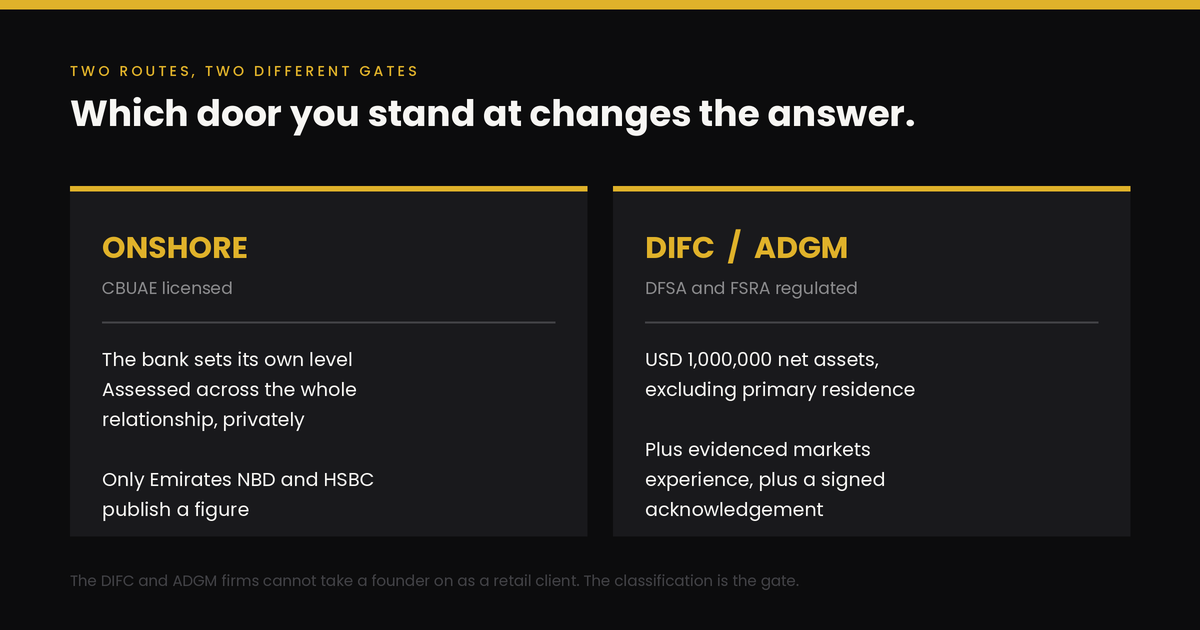
To become a client of a private bank operating out of the DIFC or the ADGM, you generally need to be classified as a Professional Client. That classification has a test:
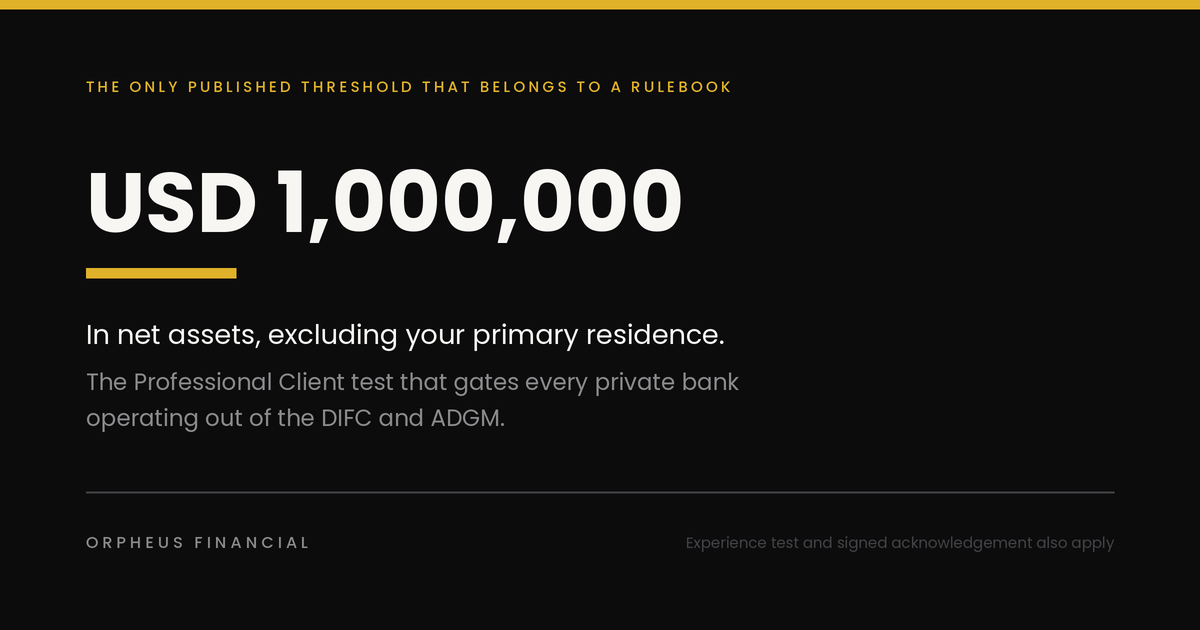
Net assets of at least USD 1,000,000, excluding your primary residence.
Relevant experience in financial markets, evidenced by investment history or professional qualifications.
A signed acknowledgement that you understand and accept the consequences of the classification.
The ADGM applies a comparable net asset test through its own regime. The two jurisdictions differ in the detail, including how joint accounts are treated, but the headline figure is the same.
This matters more than it first appears. The DIFC and ADGM private banking firms, which include the Swiss and European names founders usually have in mind, are not permitted to take you on as a retail client. The classification is the gate, and it is a gate defined by a rulebook rather than by a relationship manager’s discretion.
Onshore, the answer is whatever that bank decides, with only two institutions saying so publicly. In the DIFC or ADGM, it is USD 1 million in net assets excluding your home, plus a demonstrable track record.
Total relationship balance is not an opening deposit
One piece of vocabulary is worth getting right, because it changes the arithmetic.
Where a bank does state a figure, it is usually expressed as a total relationship balance or as assets under management, not as a sum you deposit on day one. It counts the whole relationship: current and savings balances, investments held with the bank, structured products, sometimes mortgages written by the same institution.
This cuts both ways for a founder. It means you are rarely expected to produce the headline figure in cash. It also means fragmenting your assets across four institutions is the fastest way to qualify at none of them. Consolidation is often the lever, not accumulation.
It also explains why the moment a founder crosses into private banking is usually not a funding round. It is a liquidity event. A secondary sale, a partial exit, a dividend. Something that moves value from the company’s balance sheet onto the founder’s.
The company account is the harder problem
While the personal question has reasonably clear answers, the corporate one does not, and for early-stage companies it is where most of the difficulty actually sits. UAE banks decline business account applications for a consistent set of reasons:
Source of funds that cannot be evidenced. "Personal savings" without documentation behind it is not an answer a compliance team can accept.
Incomplete or inconsistent ultimate beneficial owner declarations, particularly where an overseas holding entity has been left off the form. Banks cross-check against the free zone authority’s own register, and a mismatch between the two is a frequent cause of refusal.
Activity on the trade licence that does not match what the business actually does, or expected transaction volumes that do not match the stated activity.
High-risk activity codes. Trading, crypto and financial services draw enhanced scrutiny as a matter of course.
Insufficient substance. No staff, no real premises, no contracts, no operating history.
Bank-specific policy limits that have nothing to do with the applicant’s quality. One documented case involved a bank requiring two years of audited accounts from financial services applicants, which excluded a six-month-old company on a rule rather than a judgment.
Repeated applications. Several declines inside roughly ninety days can create informal flags that follow an applicant across institutions.
That last point deserves emphasis, because it changes the strategy. Applying widely and hoping one lands is actively harmful. The sequence matters more than the volume.
The question that comes before the banking question
Most founders approach this in the wrong order. They choose a bank and then discover that the way their assets are held does not fit what that bank is able to serve.
Where the wealth sits determines which relationship is available. Shares held personally, shares held through a holding company, assets held in a DIFC or ADGM foundation, operating entities in a free zone rather than onshore. Each produces a different answer to the Professional Client test, a different ultimate beneficial owner picture for the compliance file, and a different set of institutions that can act.
This is the part of the process that is genuinely difficult to undo once it is set. Moving a bank relationship is an inconvenience. Restructuring ownership after the fact is a transaction, with cost and tax consequences attached, and in some cases it resets the clock on exactly the history a bank wanted to see.
The structuring question is worth answering first, even though it feels like the slower route. It is the one that decides what the faster routes are.
What to do with this
Three practical steps for a founder weighing this up.
Work out which problem you are actually solving. If the company needs an operating account, that is a compliance and documentation exercise, and private banking is not the answer to it. If you personally have crossed, or are close to crossing, USD 1 million in net assets outside your home, the DIFC and ADGM route becomes available and is worth understanding properly.
Stop collecting threshold figures from the internet. Two banks publish a number. Everything else you will read is an estimate. Ask the institution directly, in writing, and ask what counts towards the balance rather than only what the balance has to be.
Deal with the ownership structure before the banking relationship. The compliance file a bank opens on you is built from how your assets are held. That question has a right answer for your circumstances, and it is cheaper to get right at the outset than to correct later.
Sources and method
Private banking threshold figures were compared across three independent publications dated 2026. Only Emirates NBD and HSBC were consistent across all three, and those two figures are the only bank thresholds stated as figures in this article. Where sources disagreed, the disagreement is reported rather than resolved.
Professional Client classification criteria for the DIFC and the ADGM are taken from published guidance on DFSA and FSRA client classification rules. Business account decline grounds and documentation requirements are taken from UAE free zone authority guidance.
Bank thresholds change without notice and most institutions do not publish them. Confirm current requirements directly with any bank before relying on a figure in this article.
This article is general information on banking and wealth structuring in the UAE. It is not investment, tax, legal or financial advice, it does not create an advisory relationship, and it may not reflect your circumstances. Obtain advice specific to your position before acting on anything in it.