
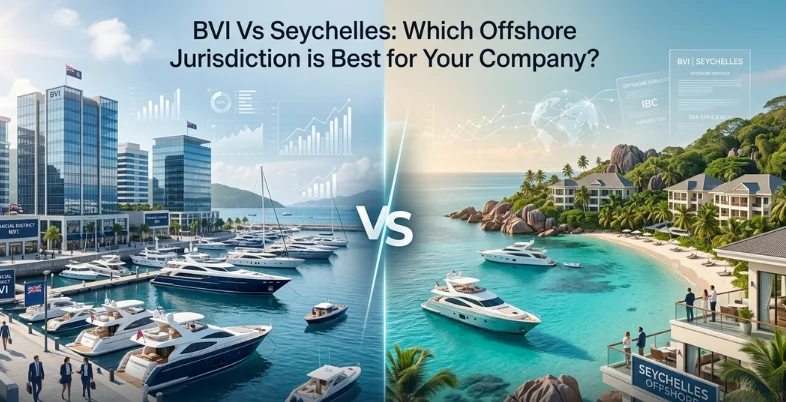
The selection of the appropriate offshore jurisdiction can determine how tax-efficient, credible, and long-term your company is. The British Virgin Islands and Seychelles are some of the most popular, as they have business-friendly regulations, tax benefits, and flexible corporate frameworks.
Although the two jurisdictions provide zero/low tax on foreign-sourced income, they vary largely in the aspects of international reputation, compliance requirements, cost, and banking ease. These differences are very important to entrepreneurs, investors, and global businesses before making a choice.
This blog compares the BVI vs Seychelles in the major aspects of taxation, privacy, legal system, access to banking, and ease of operation. Launching a startup, holding material in the world, or venturing abroad, this guide will assist you in deciding which offshore jurisdiction best suits your business objectives.
What Is an Offshore Jurisdiction?
An offshore jurisdiction is a legal and tax regime that seeks to lure foreign businesses with favorable laws, a small amount of tax on foreign earnings, greater secrecy, and less complicated company compliance.
Offshore companies are usually international in their operations and do not carry out any significant business in the state of registration.
Applications of offshore entities include tax savings, asset protection, international business, e-business, holding structures, intellectual property (IP) management, and investment vehicles. The proper choice of offshore jurisdiction is the comparison of legal frameworks, reputation, costs, compliance requirements, and long-term feasibility.
Overview: BVI Vs Seychelles
We shall begin by noticeably presenting each jurisdiction:
British Virgin Islands (BVI)
The British Virgin Islands is an ancient and established offshore financial center in the world and a UK overseas territory in the Caribbean. BVI has a powerful legal framework and is founded upon English common law and a well-developed financial base and international reputation. It is believed to be the gold standard of offshore incorporation.
Seychelles
Seychelles is an Indian Ocean island state that has established a good reputation as a competitive offshore destination and also with international business companies (IBCs). Its laws focus on economic efficiency, ease of use, and strong privacy measures.
Legal & Regulatory Framework
BVI
The BVI legal framework is founded on English common law, which offers predictability and stability. It has offshore business companies, usually referred to as Business Companies (BCs), where it provides a flexible corporate structure through its Business Companies Act (BC Act).
The BVI has also introduced economic substance requirements in companies that engage in some activities, which include investment fund management, finance, leasing, and distribution. These regulations need to show actual business presence, local management, and expenditure.
Seychelles
The Seychelles companies, particularly the International Business Companies (IBCs), are governed by the Seychelles IBC Act. Seychelles also applies economic substance requirements, but has generally weaker compliance with standard IBCs than the BVI does.
Seychelles does not require any local audit or filing and is flexible in the way meetings are held, provided that activities of the company are carried offshore.
Comparison of Costs: Installation and Operation
The cost of incorporation and maintenance is one of the most viable considerations in selecting an offshore jurisdiction, particularly for startups, small businesses, and cost-conscious entrepreneurs. The cost structures of both jurisdictions vary significantly, although both are tax-efficient.
Seychelles
The formation of companies in Seychelles is commonly considered cheaper. The fees of incorporation are also low, and the renewal costs per annum are low as compared to most of the other offshore hubs.
The simplified compliance requirements enjoyed by ordinary International Business Companies (IBCs) save a lot of administrative and professional costs on maintenance. Mostly, audited financial statements or complicated reporting is not mandatory, and, therefore, Seychelles can be convenient to trading companies, consultants, and digital businesses with international operations.
BVI
The British Virgin Islands, on the other hand, have a general increase in incorporation and yearly upkeep costs. The registered agent fees, compliance filing, and economic substance reporting, where applicable, may further escalate the costs.
These costs contribute to a good reputation of the BVI in the world and its stance in regard to regulation but might not be appropriate to those who have strict budgets.
On average, when a low cost of operation and uniqueness are the most important factors, Seychelles generally provides a less expensive option.
Taxation and Financial Advantages
Zero Corporate Tax
Both jurisdictions offer zero corporate income tax on offshore-sourced business profits, making them attractive for businesses whose operations and revenue generation occur entirely outside the country of incorporation.
Tax-Free Environment
- BVI: No corporate income tax, capital gains tax, inheritance tax, or withholding taxes on dividends, interest, and royalties for offshore companies.
- Seychelles: Seychelles IBCs also enjoy zero tax on foreign-sourced income, no capital gains tax, and no withholding taxes, provided the income is earned outside Seychelles.
Double Taxation Treaties
One notable difference is that Seychelles has a network of double taxation treaties (DTTs) with various countries, which can provide valuable tax planning advantages — especially for businesses with income streams in treaty partners.
In contrast, the BVI has a limited or negligible network of DTTs, which may lessen tax optimization opportunities for multinational companies.
Suggested Read: What Is Offshore Banking
Legal Framework and International Credibility
BVI: Strong Legal Foundation
The BVI’s legal system is based on English common law, which is well understood and respected by global courts and financial institutions. This makes BVI companies more credible and often easier to work with internationally.
- Rule of law: Strong legal protections under a stable political environment.
- Global reputation: The BVI is recognized by banks and regulators worldwide, supporting international commerce and finance.
- Regulatory alignment: Compliance with OECD and FATF standards enhances credibility.
Seychelles: Simpler but Less Prestigious
Seychelles also provides legal protections under its company legislation, but its legal system is considered less globally influential than the BVI’s. For some large global banks and institutional clients, Seychelles companies may face
Strategic Use Cases: What jurisdiction will you use?
The right offshore jurisdiction is a choice that is determined by your business goals, expansion strategies, and regulatory demands. The purpose of the British Virgin Islands and Seychelles is different.
Choose BVI if:
The BVI is the best choice for businesses that want to have high international credibility and access to international banking services more easily. International banks, investors, and regulators have great trust in its legal system, founded on the English common law. This is especially appropriate when a well-known and reputable legal framework is needed by your business or investors.
BVI is also the option of choice when the company intends to have a complicated corporate structure, possesses high-value worldwide assets, administers investment vehicles, or adds capital by institutional or venture capital sources. The reputation that a jurisdiction has tends to make due diligence activity and cross-border transactions simpler, which helps in supporting long-term scalability.
Choose Seychelles if:
Seychelles will suit better entrepreneurs who are concerned with affordable incorporation and reduced annual maintenance. It provides an easier regulatory framework and high-quality confidentiality, which attracts business people who would prefer to keep the information to themselves.
Banking and Operational Considerations
The two offshore jurisdictions are both promoters of international banking, yet ease in the real-life operation can vary greatly. Firms that are registered in the British Virgin Islands are typically well-known the world over. Consequently, foreign banks and financial organizations feel freer to accept BVI entities, and the opening of corporate bank accounts is relatively easier and quicker.
Conversely, the banks and online payment processors might impose more demanding KYC and due diligence requirements on companies incorporated in Seychelles. This is attributed to a great extent to the view of weaker regulatory authorities, although Seychelles does not break the international standards.
The jurisdiction suits trading companies, digital service providers, consultants, and asset-holding entities that are internationally based and seek limited reporting but with efficacy in taxation.
Conclusion: What Is Best for You?
When a global reputation, a good legal system, and easier banking and institutional acceptance are a priority, the British Virgin Islands (BVI) tends to be a better option, particularly for investment funds, high-value assets, and intricate company formations.
Assuming that you are more cost-conscious, simplicity-driven, high-confidence, and compliance-light, you might find more value in Seychelles, especially with startups, SMEs, and digital or trading businesses.
In the context of BVI vs Seychelles, the better jurisdiction ultimately depends on your business purpose, risk tolerance, and the specific needs of your operations. Before incorporation, it is advisable to consult an offshore corporate specialist and legal advisor.
FAQs
Q1. Do I have to visit the jurisdiction to incorporate a company personally?
A: No. In both cases, the British Virgin Islands and Seychelles have 100 percent remote incorporation via licensed registered agents and digital and online verification processes.
Q2. Is it possible for a non-resident or foreign national?
A: Yes. Both jurisdictions permit 100% foreign ownership and have no residency, nationality, or local shareholder requirements, which makes them best suited to international investors and entrepreneurs.
Q3. Will my offshore company be required to pay local taxes?
A: Companies that have offshore income that has been sourced internationally usually pay no local corporate tax. You might still have to pay taxes as per the tax residency or CFC regulations of your home country.
Q4. Can you open an international bank account?
A: Yes. Offshore companies are able to open bank accounts in the world, and banks execute stringent KYC and AML checks. The greater global credibility can be enjoyed by BVI entities, which tend to be more easily accepted.
Q5. What jurisdiction is superior to startups or large businesses?
A: Seychelles favors startups and SMEs (low costs and simplicity), whereas BVI is better suited for larger businesses, investment holdings, and structures that demand high legal reputations.


